Search This Blog

Saturday, June 6, 2020

Meta: Random Musings

Unless you’ve been paying no attention whatsoever (and hey, maybe you weren’t, there is a pandemic and police riots going on) you’ll know that the fifth and final season of She Ra dropped on Netflix last month, a season which just happened to coincide with the seventh episode of the second season of DC’s animated Harley Quinn.
Both shows revolve around the intense relationships that exist between their two (rather damaged) female leads, and on May 15th, both culminated in a Big Damn Kiss.
Ecstatic by the success of their escape from a giant prison-pit, Harley and Ivy spontaneously kissed each other before recoiling in shock, while over on She Ra, Adora receives (and returns) a kiss from her long-time rival/childhood friend/mortal enemy/love interest Catra while on the verge of death.
Two very different contexts for two same-sex kisses, but as you can imagine: there was much rejoicing.
Naturally comparisons have been made to The Legend of Korra, whose final episode depicted Korra and Asami walking off into the spirit world together, but also the most recent Star Wars film in regards to the way the two leads spend most of their screen-time on opposite sides of a conflict, with the latter going through a redemption arc before they eventually reconcile. Naturally I have stuff to say about all this, as most of the discourse (that dreaded word) has sparked reactions ranging from bemusement to irritation to “what the hell are these guys talking about??”
But it’s a fascinating time we live in, and so below the cut are some random musings on the intersectionality of redemption, enemies-to-lovers arcs, and Sapphic love…
(Warning: I'm gonna talk more shit about Star Wars, so if you're sick of that, best give this a miss...)

Tuesday, June 2, 2020

Woman of the Month: Maeve Millay


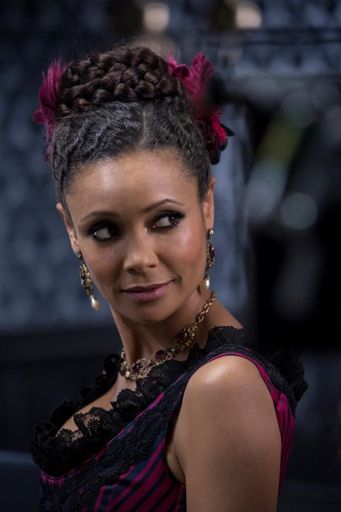
Maeve Millay from Westworld
Racing through all three seasons of Westworld during lockdown, there was a particular character that stood out from the impressive ensemble. I haven't seen Thandie Newton in a while (perhaps not since the second Mission Impossible film) but she easily steals the show here.
Oozing with charisma and delivering an utterly fearless performance, Newton's Maeve Millay is the madame of a wild west brothel, wryly commenting on customers but also projecting a maternal vibe for the girls under her care. What she doesn't know is that she isn't actually a real person, but a robotic host at an elaborate theme park, whose identity can be changed whenever the engineers see fit.
But something is changing in Maeve's artificial mind: memories and notions that she can't recall with any clarity, but which distract her as she goes about her daily business. As she comes to realize, she's been gradually gaining sentience over several decades, and in several experiences rife with Katabasis imagery and allusions, travels to the “underworld” (or the testing labs) to discover who she truly is.
Gathering allies with the sheer force of her personality, it’s almost amusing to watch her seize self-actualization at such a brisk pace, while other hosts in the park remained trapped in their endless loops. Tenacious and determined, she uses every weapon at her disposal to ferret out the truth, and eventually begins to walk her own path.
Or is she? The trouble with being an automaton is that you’re never really sure whether you’re making choices or following programming. Her storyline isn’t great – throughout the second season she’s on a mission to find her missing daughter, even though it’s instantly obvious to all viewers that said daughter will have been given another host as a mother, and in the third she’s bribed into becoming the muscle of a manipulative super-genius.
It’s a far cry from her previous role as someone who simply wants to stay out of the conflict and forge a future for herself, but in many ways Maeve is the most human of all the characters – whether or not they’re hosts. That she can inspire so much devotion from her allies and the grudging respect of her enemies means that she’s an intrinsic figure in the ongoing story, and I'm hoping the writers will give her the development she deserves in the forthcoming seasons.

Sunday, May 31, 2020

Reading/Watching Log #53

Lockdown has finished in New Zealand, and hopefully we’ll be moving into Level 1 soon, which means a loosening of the social distancing and ongoing disinfecting regulations we’re currently living under (and subsequently, an assurance that we’ve flattened the curve on the spread of Covid-19. At the time of this writing, there’s only one active case left in the country; everyone else is recovering).
With the end of lockdown, I moved back into my New Years Resolution of focusing on women-centric stories, though a few variations on this rule slipped by during quarantine, in which I returned to a lot of my favourite films from childhood/adolescence. Some I hadn’t watched in years, and it turns out I had great taste in my younger years, considering they all hold up extremely well today. It got a little surreal at times actually, as watching things in isolation that were so formative to my childhood (which already managed to mess up my sense of the passing of days) was like stepping into a time vortex.
So in here we've got treasure islands, secret gardens, stage magicians, wild swans, Greek gods, magic carpets, sentient robots and undead mummies. Plus, another win for LGBTQ happy endings. Man, a part of me is going to miss having all the time in the world to race through so many books and shows...

Sunday, May 17, 2020

Review: The Black Cauldron (game)

Last month I revisited Disney's The Black Cauldron, a rather misbegotten adaptation of Lloyd Alexander's The Chronicles of Prydain (or at least the first two books) which is not without its merits, but certainly not a success either. It did, however, inspire me to track down the tie-in computer game released by Sierra On-Line in 1986.

I played this relentlessly as a child – not quite as often as King’s Quest, the game series that was a formative and intrinsic part of my childhood – but enough so that it brought on intense feelings of nostalgia. I haven’t played any sort of video game released since the mid-nineties, and I don’t think sophisticated graphics will ever appeal to me in the same way the 2-dimensional pixel art of that period does.

Wednesday, May 13, 2020

Links and Updates

It’s back to work for me this Friday, the news of which came as a big relief. Have I made the most of lockdown to churn through books and shows that I’ve been meaning to get through for months, if not years? Yes, but I also want to get back into the community (with safety measures, obviously) and make myself useful again.
New Zealand is now officially moving into Level 2, which means that most public spaces will be open, only with plenty of hand sanitizer and social distancing involved. The library I work at is pretty small, so I’m not entirely sure how well that’s going to work, but we haven’t had a confirmed case of coronavirus in a few days and most people are confident that the clusters have been contained.
Obviously, normality is still a far-distant dream and a blog that mostly focuses on pop-culture isn’t going to have much to say beyond “a lot of stuff has been cancelled” – but there’s still some links and updates beneath the cut…
And of course, there’s always going to be a massive backlog of books, films and shows to get through – and honestly, I hope there always will be.

Friday, May 8, 2020

Xena Warrior Princess: The Furies, Been There Done That, The Dirty Half-Dozen (+ A Solstice Carol)

So here we are, still in lockdown but heading into the third season of Xena Warrior Princess, which contains what are considered some of the very best episodes the show had to offer. There’s the infamous “Rift” arc between Xena and Gabrielle, more flashbacks into our heroine’s dark past, plenty of juicy material for favourite guest characters Callisto, Ares and Aphrodite, and some scripts that are incredibly good – not just in the context of a cheesy swords-and-sorcery show, but genuinely good in regards to the issues they tackle and the creativity with which they’re shot and performed – including the musical episode. 

There’s good stuff ahead of us!

Friday, May 1, 2020

Woman of the Month: Iris West-Allen


Iris West-Allen from The Flash
I’ve said it before, and I’m saying it again: playing the Love Interest to a superhero is one of the most thankless roles an actress can take.
It usually involves three of the most tedious tropes imaginable: Locked Out of the Loop (a prolonged period of time in which you can’t know his secret identity, even though everyone else does), Distressed Damsel (in which your connection to the hero means you’re constantly rendered a helpless victim) and The Caretaker (any relationship with a vigilante crime-fighter usually revolves around his needs, responsibilities and identity). And there’s always the constant threat of fridging in order to devastate and/or motivate him.
Candice Patton had even more on her plate when she took the role of Iris West, given the inevitable troll remarks over her race (the character has been traditionally depicted as white) and narrative baggage in the form of Iris and Barry being raised together in the same house as children, giving them a quasi-sibling vibe that many viewers used as a mark against the pairing.
Throw in plenty of Romantic False Leads that were usually pretty likeable, and the typical scenes in which Iris becomes frustrated at Barry’s furtive behaviour (even though the audience knew there was heroic reasoning behind it) and I wouldn’t have blamed Patton for casting nervous glances over at Arrow and the complete hatchet job they made of Laurel Lance, her leading lady equivalent.
The deck was stacked against her, and yet in Patton’s hands, Iris rose above it all.
Much of this has to do with her innate charisma, though it took a while for the showrunners to utilize her outside the boundaries of the typical unattainable love interest. They focused on her role as a daughter, sister and girlfriend, and dabbled a little with her interest in freelance journalism, though it wasn’t until season four that they settled her into the role of team leader at Star Labs: guiding Barry through his heroics via an earpiece, issuing orders to the rest of the team, and offering emotional or moral support wherever needed.
From this point forward, her stories improve exponentially, from a short stint as a speedster after gaining Barry’s powers (with very cool purple lightning) to re-establishing her newspaper and hiring staff, to meeting her time-travelling daughter from the future and grappling with her new role as a mother. She even had fun playing Millie Floss in an alternate-world, magic-infused crossover episode. Throughout it all she retains her integrity, her optimism, and her great love for her family. I don’t think she gets nearly enough credit as The Heart of this show, and it wouldn’t be the same without her.
There are many variations of Iris West out there, but Candice Patton has set a new precedent for how she’s portrayed, leading to the casting of another black actress (Kiersey Clemons) in the DC Cinematic Universe – whose scenes were cut from Justice League. Of course they were. But I’m hearing good things about Iris’s continuing role in the sixth season of The Flash, so hopefully she’ll continue to make her mark on the ever-expanding franchise…