Search This Blog

Showing posts with label meta. Show all posts

Saturday, May 16, 2026

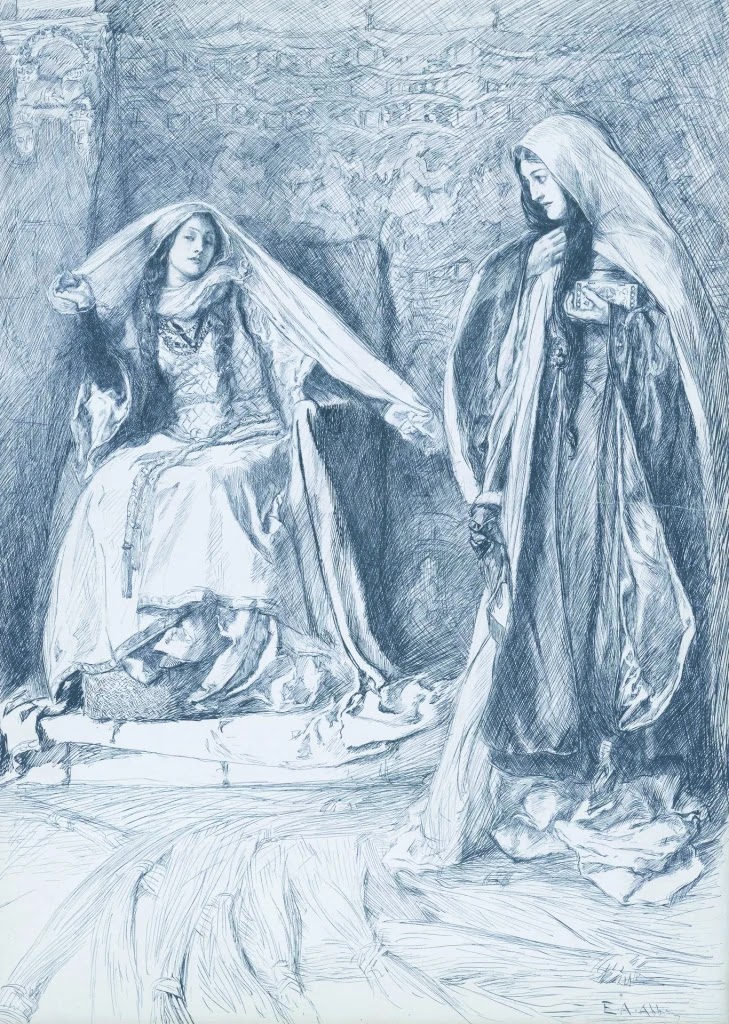
Meta: Rebecca and Rowena; Part II: The Texts

Part I: Introduction

In my last post on the subject of Ivanhoe, I wrote about how female characters (especially if there’s only two in any given project) are inevitably used as narrative foils to one another, whether it’s in the role of love interest, the embodiment of womanhood, or just in general. Sometimes it’s deliberately done by the writer, though often the audience does the comparative work on their own. After all, what’s even the point of having more than one female character if we can’t unfavourably contrast one with the other?

Lura Dolas as Rebecca and Annette Bening as Rowena in 1983

And the binaries these women inhabit are very often based on the fact they’re women. We’ve got the Madonna and the Whore, the Good Girl and the Bad Girl, the Dark and Light Feminine, Betty and Veronica, the Tomboy and the Girly Girl – I could go on.

For example, MGM’s latest take on Robin Hood has a pretty clear-cut Madonna/Whore dynamic (albeit with a degree of nuance) at work with Marian and original character Priscilla. Marian is virginal and sweet-natured, while Priscilla is a sexually active manipulator. The show also introduces a third type: Ralph, a girl living rough in the forest in the guise of a boy, who is obviously much more tomboyish than either Marian or Priscilla, and who makes up the third point of a love triangle with Robin. That each woman exists as a direct contrast to the other two is very deliberate.

But now I want to take a closer look at Rowena and Rebecca as they exist within Walter Scott’s novel, and then William Makepeace Thackery’s parody Rebecca and Rowena. The point that fascinates me is that they are very seldom compared to each other in Scott’s original text, but Thackery’s treatment of each character is a quintessential case of how fandom (or audiences in general) is predisposed to judge women by pitting them against one another.

And in a way it’s a shame, as Scott’s text invites no such treatment of them.

Sunday, April 26, 2026

BBC's Robin Hood: The Bechdel Test

It’s the twentieth anniversary of the BBC’s Robin Hood, which aired its first episode on the 26th April, 2006. In the leadup to this date, I’ve been trying to think up ways of commemorating the occasion, and along with linking last year’s ranking of the show’s thirty-nine episodes on Tumblr, I’ve edited together all the scenes of the show passing the Bechdel Test:

And because I’m anal retentive about this sort of thing, here’s a second video of female characters on the show not passing the Bechdel Test:

As I’m sure you know, the Bechdel-Wallace Test is a metric designed to measure the role of women and their interactions within any give media. For a work of fiction to pass the test, it requires a) two women who b) have a conversation about c) something other than a man.

It’s obviously not a fail-proof method of ensuring that your story will be a feminist triumph, as plenty of awful films can throw in a couple of superfluous lines between two women discussing local news, while superior films can fail the test by dint of having only a single female character. It is not a way to judge the quality of stories themselves, and was never designed to be in the first place. It’s no more or less than an interesting thought experiment, and a baseline gauge of how female characters are written.

I found it quite fascinating to parse Robin Hood through the requirements of the Bechdel Test, though you won’t be surprised to learn it wasn’t a sterling example of the test in action (it clocked in at seven minutes and ten seconds of women talking to each other in a show that ran for approximately 1,755 minutes altogether). Still, sometimes you have to be realistic about what a story is trying to offer. This was always skewed towards a young male demographic, and you could probably say the same for most Robin Hood adaptations.

Still, that doesn’t mean I’m not interested in the role of women in this show, which is why I put together this edit in the first place. And I have by necessity been very generous with the conditions of the test…

Saturday, December 27, 2025

Meta: Comparing/Contrasting Andor and Black Sails

“Love, it seems, has triumphed over virtue.” 
– Renault, Casablanca

This year I completed two incredibly good television shows: the second (and final) season of Andor (2022 – 2025) and all four seasons of Black Sails (2014 – 2017). You don’t need me to tell you that one garnered considerably more online discussion than the other, but on recommending Black Sails to a work colleague recently, I found myself saying: “it’s just like Andor!”

It wasn’t until I got home that I thought back to my comment and wondered why exactly I had made that comparison. At first glance, the shows have very little in common: one is a sci-fi espionage thriller set in a galaxy far, far away; the other a historical epic set during a specific period of own history (the Bahamas, 1715) with many characters based on real-life people. One comprises a small part of a sprawling, multi-million-dollar Disney franchise, while the other is a high-budget but relatively little-watched Starz show that ran for a respectable four years.

Yet they both boasted high production values, talented casts, and hefty themes concerning warfare, oppression, conviction, the moral and emotional cost of resistance, and the question of how far an individual can pursue a righteous cause before it’s deemed (either by themselves, the society around them, or the audience itself) that they’ve gone too far.

Both have ensemble casts full of morally complex main characters, which have set themselves for or against a powerful Empire, a struggle in which they’re called upon to make difficult moral decisions, are forced into conflict with their allies almost as much as their enemies, and face the impossible choice between protecting those they love, or sacrificing everything to the furtherment of a cause they fervently believe in.

More specifically, both narratives revolve around the idea of revolution – why people fight for it, and what price it exacts from those who engage in it. Just as Cassian Andor and the rebels of Star Wars are mired in espionage against the Galactic Empire, so too are the pirates of Black Sails gradually preparing for war against the British Empire.

I’ve seen each show described as a workplace drama, which is a fair assessment of each one if you take into account the interest both stories have in the concept of “the work” or “the cause”: from how a character can find themselves working with those they may dislike or distrust to achieve their goals, to how their friends, morals and relationships will inevitability be compromised because the work/cause is paramount.

Coincidentally, the shows are also prequels to pre-existing material: Andor to Rogue One (which is itself a prequel to the original Star Wars trilogy) and Black Sails to Robert Louis Stevenson’s Treasure Island.

Most importantly, both are extremely well-written. For this reason, I’m in the mood to delve further into the details of each show, how it is they’re in such simpatico with each other, and why each one is almost universally regarded as that most elusive of subjectivities: good. Sometimes, it’s just nice to gush about things you enjoy, and in doing so, I can hopefully provide you with a litany of reasons as to why you should watch each one.

SPOILERS FOR ANDOR AND BLACK SAILS

Monday, October 20, 2025

Meta: The Evolution of the Vampire

 Darkling I listen; and, for many a time

         I have been half in love with easeful Death

– John Keats

Earlier this year (May, to be precise) I read and watched a number of vampire stories. This month I went with friends to see Dracula performed as a ballet. Across that time, I was continually stunned to notice striking similarities between so many takes on the same subject matter, similarities which were all the more interesting because they weren’t present in the source material upon which these later adaptations were based.

Said source material is comprised of Sheridan Le Fanu’s Carmilla (published 1871) and Bram Stoker’s Dracula (published 1897). The subsequent adaptations are Francis Ford Coppola’s Dracula (1992), NBC’s short-lived Dracula (2013), Emily Harris’s Carmilla (2019) and Robert Eggers’s Nosferatu (2024). What they all have in common is that – contrary to the original texts – their vampire characters are unambiguously portrayed as alluring and inviting and erotic. Well, maybe not Nosferatu exactly, but that didn’t stop a certain segment of fans for finding him so anyway.

But what really caught my attention is that all four stories center on a young woman, one who is caught between the comfort and safety of her every-day existence, and the danger and horror inflicted upon her by the vampire’s intrusion into her life… except that this isn’t how the adaptations frame it.

Instead, each film or show creates a love triangle of sorts, one between a woman who is unsatisfied with her life, the stifling societal norms and patriarchal conventions that surround her (usually represented by her fiancé or husband) and the freedom and modernity that the vampire offers her. To one extent or another, this is the case in all four of the above-mentioned adaptations, and certainly not the case in the two stories upon which they are based.

So, why exactly has there been such a dramatic shift in how vampire-related material is interpreted? One which is apparently so pervasive that it’s appeared in several otherwise unconnected variations of the same story?

Saturday, September 13, 2025

Meta: Rebecca and Rowena; Part I: Introduction

Note: I have been working on this post for several months now, and it just keeps getting longer and longer. As such, I’ve decided to break it down into four parts: the introduction, the novel/parody novella, the films, and the television adaptations.

Every now and then I come back to this article in The Toast about The Unified Theory of Ophelia, in which the author half-jokingly claims that they once believed everything there was to know about womanhood could be discovered in the character of Ophelia.

I had a similar revelation last year on reading Walter Scott’s Ivanhoe and watching its assorted film and television adaptations (plus, William Makepeace Thackery’s parody novella). Everything about how female characters are portrayed across media, how fandom responds to them, and even how Love Triangles and Fan-Preferred Couples form in the imaginations of readers/viewers, can arguably be found in media’s collective portrayal of Rowena and Rebecca across the centuries.

Source

I would go so far as to say that the genesis of all fandom’s discourse and harassment and cross-examination and hypersensitivity and preoccupation with female characters and the role they play in any given narrative can be traced back to these two fictional women. Is that too broad a claim? Yes, of course – but as the linked article points out, every now and then certain theories and concepts that interest you can occasionally seem to magically coalesce into a single, shining, straightforward example. It’s like discovering the unifying theory of the universe.

Saturday, November 20, 2021

Meta: The Problem With Witches

Yikes, it’s been dead around here, but real life has an annoying way of cutting into one’s blog-time. Have some random musings on witches in pop-culture...

This post doesn’t have any sort of profound conclusions to be drawn from it, rather it’s more of a series of observations that I noticed while knee-deep in my October viewing of witch-related media.

Saturday, January 2, 2021

Women of the Year: A Retrospective 2020

If you’re reading this, then you survived 2020. Congratulations. It was a year that’ll be defined by the Coronavirus pandemic and the lengths we all went to in trying to contain its spread, the consequences of which will be felt for years to come. Several weeks were spent in lockdown, which afforded us all one sliver of a silver lining: time to catch up on our backlog of reading and viewing material.

Wherever you are in the world, I hope you had a satisfying Christmas and New Year, even if it was considerably more low-key than usual.

As you may remember (as I’ve brought it up enough times) my profound weariness with the way female characters were treated throughout 2019 inspired my New Year’s Resolution: that I would try to focus on women-created and women-led media for the duration of 2020. For the most part I stuck to this promise, seeking out material that I might not have even heard of without this prerequisite, and it was rewarding to not only discover so many new stories and great female characters, but also revisit plenty of my own favourites.

The twelve most significant heroines of the year were featured in my Woman of the Month series, but there are always plenty more that are notable for their charm, complexity, uniqueness, and tenacity. They all got me through this year...

Saturday, June 6, 2020

Meta: Random Musings

Unless you’ve been paying no attention whatsoever (and hey, maybe you weren’t, there is a pandemic and police riots going on) you’ll know that the fifth and final season of She Ra dropped on Netflix last month, a season which just happened to coincide with the seventh episode of the second season of DC’s animated Harley Quinn.
Both shows revolve around the intense relationships that exist between their two (rather damaged) female leads, and on May 15th, both culminated in a Big Damn Kiss.
Ecstatic by the success of their escape from a giant prison-pit, Harley and Ivy spontaneously kissed each other before recoiling in shock, while over on She Ra, Adora receives (and returns) a kiss from her long-time rival/childhood friend/mortal enemy/love interest Catra while on the verge of death.
Two very different contexts for two same-sex kisses, but as you can imagine: there was much rejoicing.
Naturally comparisons have been made to The Legend of Korra, whose final episode depicted Korra and Asami walking off into the spirit world together, but also the most recent Star Wars film in regards to the way the two leads spend most of their screen-time on opposite sides of a conflict, with the latter going through a redemption arc before they eventually reconcile. Naturally I have stuff to say about all this, as most of the discourse (that dreaded word) has sparked reactions ranging from bemusement to irritation to “what the hell are these guys talking about??”
But it’s a fascinating time we live in, and so below the cut are some random musings on the intersectionality of redemption, enemies-to-lovers arcs, and Sapphic love…
(Warning: I'm gonna talk more shit about Star Wars, so if you're sick of that, best give this a miss...)

Sunday, March 8, 2020

Meta: My Favourite Little Women...

My head is still full of Little Women, and since there have been so many adaptations over the years, I felt it was time for a post that ranked the best portrayals of each character. By which I mean the four sisters, their suitors and other important characters (I won't bother with minor characters such as Hannah or Mr March).
And for the record, I wouldn't dare say that my choices are the objective best, but rather are just my personal favourites that you can agree or disagree with as you see fit.

Friday, January 3, 2020

New Year's Resolution: As Wrapped Up in an Angry Emotional Womanly Rant

disappointment
/dɪsəˈpɔɪntm(ə)nt/
noun
sadness or displeasure caused by the non-fulfilment of one's hopes or expectations.

I learned an important lesson in 2019: that I'm a deeply stupid person. I am stupid because I continually let myself get invested in stories that are destined to fail their female characters, people of colour, and LGBT communities.
It's not the worse thing that can happen to a girl: I have a job I enjoy, friends I love and a comfortable place to live. I'm keeping all this in perspective. But 2019 brought into focus a very disturbing trend of how female characters are treated when they're in the hands of male writers.
It's always been there, but the ways in which the stories of women have concluded in three of our biggest franchises, all of which came to their conclusions this year, have helped me find a way to articulate it properly for the first time.
We have a very serious problem with the proliferation of three deeply ugly tropes. TV Tropes calls them Stuffed in the Fridge (women dying so a man can be sad, angry or motivated), Drop Dead Gorgeous (depictions of beautiful dead women) and Interplay of Sex and Violence, the worst of all considering it often combines the first two. They were all over some of the most iconic female characters of the decade, in some of the most popular films and shows that aired this year.

Tuesday, November 19, 2019

International Men's Day: Top Ten Favourite Male Characters

It's International Men's Day, and I've decided to celebrate by showcasing some of my favourite male characters.
What they all have in common is a deep sense of kindness and compassion for others - which unfortunately, are traits that are not only in short supply these days, but often looked upon with contempt and ridicule. I'm reminded of a line spoken by Naomi Watt's character in The Painted Veil in which she scoffs: "As if a woman ever loved a man for his virtue," and looking around at the type of men that fandom usually stan for, it's not hard to see her point.
Or as Simone Weil wisely put it: “Imaginary evil is romantic and varied; real evil is gloomy, monotonous, barren, boring. Imaginary good is boring; real good is always new, marvelous, intoxicating.”
That assertion is up for debate, but an unfortunate side-effect of the assumption it raises is that heroic fictional characters, those who try to make the world a better place either through small acts of kindness or great feats of derring-do, are often dismissed as uninteresting, whereas those who commit themselves to violence, hatred and destruction are considered as sympathetic as they are fascinating.
Putting aside fandom's preferences, because YES I KNOW it's just fiction and shipping isn't morality, I still want to draw attention to the portrayals of good men in our media. Because simply put, I like seeing depictions of gentleness, compassion and empathy in any type of human, and it's Hercule Poirot who put it best in Evil Under the Sun: "To count - to really and truly to count - a [person] must have goodness or brains."
So these are some of my favourite male characters, not because they're morally compromised, or conflicted, or have sad backstories that justify their serial killing - but because they're fundamentally good people, and no less interesting because of it.

Tuesday, September 10, 2019

Meta: Why Aladdin and Jasmine are the Best Disney Power Couple

In hindsight it seems sad and strange that I picked Princess Jasmine to be March's Woman of the Month, Disney's first and only Middle Eastern Princess, knowing what happened in Christchurch just a few weeks later.
Aladdin came in for its fair share of criticism when it was first released, from its cartoonish portrayal of a fantasy Arabian city, to the ethnically-coded features of Jafar, to the infamous: "it's barbaric, but hey, it's home" lyric (the original lead-in to this was: “where they cut off your ear if they don’t like your face…”)
A few "praise Allahs" and "salaams" are scattered throughout, and yet the tone is so intrinsically American and its narrative so Western that it can barely be described as a Middle Eastern tale at all. Disney took an aesthetic (or rather, the parts of it that were recognizable to Western audiences: the minarets, the harem girls, the turbans and scimitars – regardless of their authenticity) and wrapped it gauzily around a Disney tale of heroism, romance and believing in yourself.
The critique is out there, and it’s worth reading.
And yet despite the Disneyfication of the original Aladdin story, however much they diluted the culture upon which the film draws its inspiration, it nevertheless contains two likeable, relatable, three-dimensional leads – who happen to be Middle Eastern.
And though that fact may seem like a tiny drop in the ocean of the relentless awfulness in the world right now, this year it's been a balm. I saw the stage show in February for my birthday, re-watched the original animated film with my Disney-deprived friend a couple of weeks ago, and will probably see the live-action version when it's out on DVD later this year. From start to finish, and on so many levels, it's a great story.
So, I'm gonna talk about it some more. Specifically, why I think Aladdin and Jasmine are the best Disney power couple. Because what's the point of having your own blog if you can't go deep down the rabbit hole of your own incredibly specific interests? 

Monday, November 26, 2018

Meta: Contrasting/Comparing Three Halloween Films

I realize Halloween was a few weeks ago now, but it was as good a reason as any to watch three of my favourite spooky movies and contrast/compare them. Because why not?


It's actually rather fascinating to see how scary movies for young audiences have deeply rooted similarities in their structure, characterization and moral framework. The earliest, Hocus Pocus, came out in 1994, followed by Monster House in 2004 and Coraline in 2009, giving us a trio of horror stories aimed at children in which young protagonists battle malevolent forces that are rooted in folklore and legend (urban or otherwise): one in live-action, one in CG animation, and one in stop-motion animation.
Although Coraline is not strictly speaking a Halloween movie (it's the only one of the three not set on October 31st) all of them feature young people on the verge of adolescence in considerable danger from the supernatural.

Saturday, September 22, 2018

Meta: A Merlin Retrospective Part II

Continuing on from the first half of my ongoing Merlin retrospective, here are the rest of my favourite episodes from seasons three, four and five. As you can imagine, things get a little dire after season three, but there are still some good characters, scenes and ideas that manage to wriggle their way through the dross.

Friday, September 21, 2018

Meta: A Merlin Retrospective Part I

It was ten years ago today that the first episode of Merlin aired. Yes, you read that right: ten years. Not five, but ten. A solid decade.
All these years later, I have to admit that I haven't really given the show much thought since its conclusion. No matter how good preceding episodes or seasons might be, if a long-running story doesn't stick the landing, an audience has little reason to return to it.
And despite a rich premise and a wonderful cast, the show never made good on its promises. Storylines were spun out in endless circles, entire swaths of character development occurred off-screen, and the central hypothesis of the whole show (that Arthur and Merlin would build a magic-friendly kingdom of peace and glory together) never actually came to fruition.


In my mind, Merlin came to an ending at the end of the third season, with a finale that certainly has a lot of threads left dangling, but which also leaves our main characters in a good place. Sure, stopping here means we don't see Arthur become king, Guinevere become queen, Morgana get defeated or Merlin finally revealing his secret – but then seasons four and five didn't bother capitalizing on these developments either; not to any meaningful extent.
May as well quit when you're ahead.
And don't get me started on the fandom. My previous fandom was also my very first fandom: the BBC's Robin Hood, which spoiled me with its chilled-out attitude and ability to conduct reasonable discussions.
In comparison, the Merlin fandom was one giant screaming cesspit of misogyny and racism, in which slash shippers seemed certain that if they levelled enough harassment and hatred at Angel Coulby's Guinevere (who incidentally walked off with the closest thing to actual character development and a satisfying narrative arc) they would get to see Merlin and Arthur make out at some point.
This plan didn't work, and it's to my continual joy that both Angel and Katie McGrath (another target of relentless ire) have enjoyed consistent work since Merlin wrapped up.
But despite the ups and downs, I can't disregard the five years I spent with Merlin. (You know all those episode summaries on TV Tropes? Yup... that was me). Back in those days I had to wait for episodes to be uploaded onto YouTube, was working with extremely limited Broadband, and didn't have a Tumblr account (I would just lurk on other people's dashboards in order to see all the GIFs).  Heck, I didn't even have this blog. Those were the days of LiveJournal, where you can still read my reviews of season four and five episodes.
But I have fond memories of watching Merlin clips and homemade MVs on YouTube, and of the imaginative scope the show afforded me in the way it left so many stones unturned; so many avenues unexplored, that new ideas and story possibilities sprung up in my own head.
So I wanted to do something to commemorate the beginning of Merlin, and so have dug out the extremely long retrospective I wrote at its conclusion. Because it was first published on LiveJournal, which has no mechanism for seeing how many hits a singular page is getting, I have no idea how many people read it when it was first posted. However, I saw it talked about and linked to a few times in the wider fandom, so I suspect it was one of my more popular offerings...

Monday, September 10, 2018

Meta: Defying the Fridge

I just finished the most fantastic book called The Refrigerator Monologues by Catherynne M. Valente, which tackles the subject of Women in Refrigerators through the format of The Vagina Monologues.
I loved it. More of a novella than a fully-blown book, it's a collection of first-hand accounts from various female characters who don't make it to the end of the story – they're the girlfriends who die so their male counterparts can get motivated or be angsty or just get on with his superhero lifestyle without any distractions.
Most of my thoughts about will keep until my end of the month Reading Log, but for now I'll just say that you can tell it's written from a place of deep frustration, and this article by Valente explains her inspiration: watching the death of Gwen Stacey in The Amazing Spiderman 2.
Then I made the mistake of reading the comments. Amidst the usual snowflake pearl-clutching about how the feminist agenda is infecting literature and destroying lives, there was a depressingly repetitive refrain, used as justification for the death:
"Gwen Stacey always dies."
Gwen Stacey always dies. The words are spoken like it's an explanation in and of itself. That's like... the whole point, guys. That's her purpose; her reason for existence. She lives so she can die. It's hard to properly articulate why this mentality is so depressing.
Look, I'm not so daft as to believe female characters should be immune from death, but it's the frequency with which women perish, and the reasons for why they do so – but that's for another post entirely.
This post is actually a positive one. Below are a list of female characters who defied the fridge. Despite all the odds being stacked against them, despite foreshadowing and precedence and fandom expectations and even narrative inevitability, these women refused to be stuffed in that damn refrigerator.
Their places in these narratives aren't defined by the pain their deaths inflict on male characters – instead they are given the right to live and thrive and tell their own stories.

Monday, January 22, 2018

Meta: Alias Grace ... what the hell?

I've recently finished Alias Grace, a six-part miniseries that's riveting, engrossing and fascinating, and which you should watch right now if you haven't already. Based on the real-life arrest, imprisonment and eventual pardoning of Grace Marks for her involvement in the murders of her employer Thomas Kinnear and his housekeeper Nancy Montgomery, Margaret Atwood weaves a story around the established facts of the case that explores (as you might expect) womanhood, storytelling, and how the perception of others can shape our lives.
This post is for those who have already seen the miniseries (or read the book) for it is an attempt to provide three possible explanations for the mystery of Grace Marks (as presented here) and the events that took place on that fateful day in July 1843 when Kinnear and Nancy were killed.
There are three possible scenarios that the show leaves us with:

Friday, March 17, 2017

Meta: The Assigning of Blame among Fictional Characters

With the release of Disney's live action Beauty and the Beast in theatres, I did what any fan that grew up in the Nineties would do: watched the original animated version instead. I'll probably see the new one eventually (if not simply to complain about it) but my philosophy is that if you want to remake something, do so because you can make the original better. And in the case of the animated Beauty and the Beast, you can't improve on perfection.
But I'm not actually here to talk about Disney fairy tales or their remakes – instead I want to discuss two lines that caught my attention as I watched the animated film for what must have been the hundredth or so time. When Belle and her father are trapped in the cellar as Gaston and the townsfolk ride out to confront the Beast at his castle, Belle turns to her father and cries: "this is all my fault!"
Later she repeats the words when cradling the Beast's body in her arms, telling him: "this is all my fault; if only I'd gotten here sooner."
The words rang a bell, but it wasn't until reading this review of Aladdin that I realized why. In that movie the protagonist has a line that's almost identical (at least in sentiment) to Belle's, crying: "this is all my fault – I should have freed the genie when I had the chance!"
So what point am I trying to make here? The link above points out something interesting: that when Aladdin admits blame for the situation he's found himself in, it's actually true. He should have freed the genie when he had the chance. Breaking his initial promise to do so after his first two wishes had been granted gave Jafar the opportunity to steal the genie's lamp and wreak havoc on Agrabah.
And it was Aladdin's own insecurities that led to this decision, making it a mistake born out of the character's foibles. It's a bad choice not made accidentally or without full knowledge of the situation – but out of fear and selfishness.
Compare this with Belle, who twice states that everything is her fault, and yet clearly can't be blamed for any of the terrible events that occur in the movie. Perhaps she's holding herself responsible for showing Gaston and the townsfolk an image of Beast in the magic mirror? If so, the audience can't be too hard on her considering she did it to save her father from being dragged off to the asylum.
And her statement that: "if only I'd gotten here sooner"? Come on, she was clearly travelling as fast as she could, and I'm not sure what she could have done to interrupt the Gaston/Beast fight if she had returned a few seconds earlier anyway.
It made me realize that the words: "it's all my fault" are uttered quite a lot in movies/television by a variety of different protagonists. Something terrible has happened, and because they're the main character, they are guilt-ridden. The blame lies with them, even when it clearly doesn't.