Search This Blog

Showing posts with label television reviews. Show all posts

Saturday, October 26, 2024

Review: Buffy the Vampire Slayer: Season 1

My rewatch of all seven seasons of Buffy the Vampire Slayer isn’t exactly going at the steady clip I initially hoped it would, but hey – slow and steady wins the race. Furthermore, my fond memories of this show are very much based on the earlier rather than the later seasons, so it’s not like I’m in any hurry to leave the high school years.

First, the story of how I discovered Buffy in the first place. It’s not profoundly interesting, but the beginning is a very good place to start.

Monday, May 15, 2023

Review: Shadow and Bone: Season 2

Remember that episode of Friends when Rachel and Chandler were fighting over the cheesecake and it ended up all over the hall, but tasted so good that they just ate it off the floor? That’s the best analogy I have for season two of Shadow and Bone. It’s delicious, but it has, in fact, exploded all over the floor. Or, if you like, it has exploded all over the floor, but it still tastes delicious.

Perhaps this was inevitable. On the one hand, there’s the looming spectre of cancellation-happy Netflix hanging over the show, which no doubt made everyone want to squeeze in as much material as they could just in case the axe falls. Then there’s showrunner Eric Heisserer’s open preference for the Six of Crows characters, inserting them into the narrative at every available opportunity and expediting Alina’s story to get to theirs.

Even the structure of the Grisha-verse book series itself poses a problem, starting with the Shadow and Bone trilogy* which was a standard YA trope-ridden fantasy of “plucky girl plucked from obscurity negotiates love triangle while saving world from sexy dark lord who has the hots for her.”

* Simultaneously kickstarting the current surge of Slavic fantasy novels and the YA trend of [noun] and [noun] titles, including A Court of Frost and StarlightThe Girl of Fire and StormA Curse So Dark and LonelyA Book of Spirits and ThievesA Sorrow Fierce and Falling, and Girls of Storm and Shadow, which is part of the Girls of Paper and Fire trilogy – yes, those are all for real.

The trilogy was followed by the Six of Crows/Crooked Kingdom duology, which deliberately set out to buck those clichés, a gas-lamp fantasy centred around a heist and the complex dynamics and backstories of its six core characters. Lastly, there’s the King of Scars/Rule of Wolves duology, which wrapped up plot-points, character arcs and political situations from the previous two sets of books. There’s also a couple of short story collections, such as The Language of Thorns and Lives of the Saints, which provide more details on the world’s invented mythology.

The second season of the Netflix show builds its story from nearly all these books: Siege and StormRuin and RisingCrooked KingdomKing of Scars and Lives of the Saints, which is how we get to the exploded cheesecake.

Saturday, June 12, 2021

Review: Shadow and Bone: Season 1

The Netflix adaptation of Leigh Bardugo’s Shadow and Bone was a viewing event. I’d read all the available books (excepting Rule of Wolves) and put the release date on my calendar, opting to travel to my friend’s house and watch the whole thing across a single weekend (four episodes per night) on his big screen television. I took this seriously!

I’d consider myself a fan of the book series (currently made up of one trilogy and two duologies, plus a smattering of short stories) for their dark fairy tale ambience and moral complexity, especially in Six of Crows and Crooked Kingdom. Leigh Bardugo is a writer who knows her audience, what with her mastery of witty banter, traumatic backstories and shipping tropes, and yet she avoids certain pitfalls of other popular YA writers. There is little in the way of wish fulfilment here, and it’s replaced with a genuine sense of weight when it comes to her subject matter.

The whole thing was ripe for a streaming adaptation, and I sincerely hope that we’ll get the chance to see the entire saga play out, despite the “changing of the guard” when it comes to the protagonists: from Alina to the six Crows to Zoya and Prince Nikolai (not even introduced in the series yet) across the three sets of stories.

We’re off to a good start, with a first season that’s far from perfect, but which has a decent budget, an engaging premise, and spot-on casting. Seriously, everyone looks and behaves exactly like their book counterparts – even when some creative liberties have been taken. Alina and Mal were white in the books, and are here played by bi-racial actors, yet they embody their characters so perfectly I won’t be able to picture anyone but Jessie Mei Li and Archie Renaux in the roles from now on.

This rather negative (but fair) review points out that you can tell the show is YA by the way the material focuses on relationships over world-building, with romantic complications and love triangles taking precedence over what could have potentially been a genuinely fascinating political setup. I’ll delve more into that later, but watching the show and being aware of its target audience had the unexpected side-effect of making me feel old for the first time in my life.

Which is ridiculous since I’m still younger than Ben Barnes – and yet when I last skyped my sister and mentioned watching it, she (totally unprompted) said: “it made me realize I’m not a teenager anymore.” So it obviously had the same effect on other people too!

Even the show itself seems oddly self-conscious about the fact only one significant cast member is over the age of forty-five, to the point where a joke is made in which Jesper has to impersonate someone significantly older than him, and is indignant that anyone could think he would pass for that age – only for a snide official to tell him: “I thought you were older.”

The joke falls completely flat, since... my God, they’re CLEARLY all children! And to add another layer of irony on top of that, these actors are STILL at least a DECADE older than the characters they play in the books! Matthias is meant to be the only legal adult at eighteen!

So, if you plan on recommending this to co-workers or friends, do as I did and add the disclaimer that it’s the most YA thing they’ll ever see and may induce a premature mid-life-crisis.

Saturday, April 25, 2020

Review: Emma (yes, all of them)

Over the last four weeks I’ve discovered the perfect combination of comforts for surviving lockdown: chocolate and Jane Austen – specifically Emma, her fourth published work and arguably her best novel. 
Yet even with nothing else to do, I didn’t have the time or energy to reread the book itself, so I made do with all five adaptations of the story, from the BBC’s miniseries in 1972, the Gwyneth Paltrow vehicle in 1996, the second BBC adaption to come out that same year, their third televised attempt in 2009, and Autumn de Wilde’s interpretation of early 2020.
The story certainly knows how to time itself, averaging one (nearly) every decade, at (rough) ten year intervals.
I’ve often believed that the reason Emma and Pride and Prejudice are over-represented in media is due to the fact Elizabeth and Emma are spirited in a way the ladies of Mansfield Park and Persuasion aren’t. Austen was saying something very different about social expectations and personal fortitude in her treatment of Anne Elliot and Fanny Price, which has inevitably led to screenwriters finding them “less fun”... but perhaps not entirely without reason. 
Elizabeth and Emma are more dynamic characters; they are different women at the end of their stories than they were at the beginning. It’s perhaps due to the internal change required of its main character that Emma is generally considered Austen’s finest work (even if Pride and Prejudice remains her most beloved) with a protagonist that is deeply flawed yet all the more lovable for it. 
According to Austen herself: "I am going to take a heroine whom no one but myself will much like", and yet we do like Emma – not in spite of her faults, but because of them. Her snobbery, her meddling, her foolishness – it’s all so entertaining that it’s almost disappointing when she grows out of it.
Austen also deserves credit for taking the familiar beats of a romance novel and turning them inside out. In any other story it’s beautiful, impoverished and musically gifted Jane Fairfax who would be our protagonist, with Frank as the dashing, unpredictable love interest who promises to save her from a life of destitution if only she can endure the secrecy that’s required to survive his formidable aunt.
Emma stands in ignorance of the drama happening right under her nose, never doubting that she’s the main character but not realizing the point of her arc is to realize how wrong she is about everything, and that her true love isn’t the charming, enigmatic Frank but George Knightley: old family friend, next door neighbour and technical brother-in-law. 
All of Emma’s matchmaking attempts end in disaster, she completely misinterprets Mr Elton and Frank Churchill, and is completely wrong about everything. She’s… dare I say… clueless?
Emma Woodhouse is also unique for being the only one of Austen’s heroines who is under no familial, financial or even societal pressure to marry. She has no need to worry about her well-being or that of her family, and her father's desire to keep her close only increases her power. She can do whatever she likes, and so when she does eventually wed, it’s entirely because she wants to. 
It gives the book a lightness of spirit that’s missing from her other works, in which Elizabeth, Anne, Elinor and Marianne have to  actually worry about their futures and financial situations, and I suspect that’s another part of the reason why Emma has been adapted so often. So many readers – rightly or wrongly – look upon Austen as escapism, and as such Emma’s complete lack of poverty or long-term worry becomes the most appealing aspect of her story.

Monday, April 13, 2020

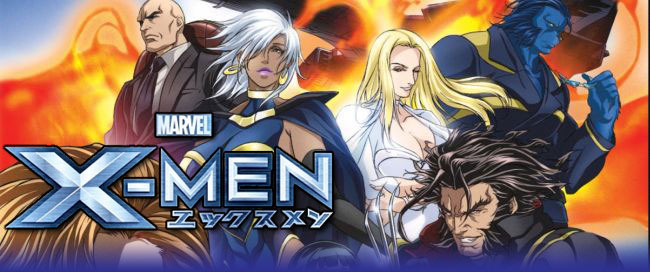
Review: Marvel Anime: X-Men

Before starting my rewatch of the animated X-Men adaptations, I had no idea this anime even existed. According to Wikipedia, the show was one of six animated collaborations between Marvel Entertainment and Madhouse studios (four series and two films in total). Airing between 2010 and 2012 in Japan and North America, the project also included Iron Man and Blade, as well as a solo Wolverine outing – which I'll get to next.

I've no idea how familiar the creators were with its direct predecessor Wolverine and the X-Men, but coincidentally or not, X-Men Anime also begins with the apparent death of Jean Grey and revolves around a mystery involving the trustworthiness of Emma Frost. It's also something of an inversion of X-Men Evolution, for whereas that show ended with a brief glimpse of Jean turning into the Phoenix, this one starts with it.  
In a short flashback, Phoenix-possessed Jean self-destructs in front of her teammates as a desperate last resort, leaving Cyclops devastated and the X-Men disbanded. It's a strong opening, and one that really captures the destruction and chaos the Phoenix wrought in a way no other adaptation has – but as it turns out, this series has virtually nothing to do with The Phoenix Saga. All that matters is that Jean is dead and Cyclops is heartbroken, and believe it or not, she doesn't return to life by the final episode.
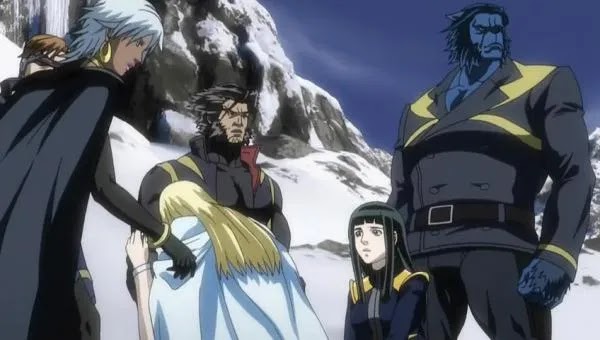
The plot starts properly when the core members of the X-Men – Cyclops, Storm, Beast and Wolverine – are contacted by Professor X and asked to return to the mansion. He has a new mission for them, one that involves a trip to an isolated area of Japan that he finds impossible to scan with Cerebro. Something is blocking his efforts, and on arriving in the Tohoku region it becomes clear that something is very wrong: not only are there deformed fish in the streams and dead trees on the riverbank, but twenty young mutant children have gone missing.


Naturally, mutants are copping the blame for the trouble (and local police aren’t pursing the case for this precise reason), though the team is surprised to find such a large percentage of mutants amidst what is such a small population – especially since Cerebro is unable to penetrate the area. And so the investigation begins...
There are twelve episodes in all, each only about twenty minutes long, so things whizz by pretty quickly, with all the staples of anime that you’ve come to expect: gravity-defying boobs for the women, a tendency for men to get their shirts shredded to reveal six-pack abs, prolonged montages of reaction shots from characters (usually punctuated with gasps or grunts), and lots of uncomfortable butt poses.

Monday, April 6, 2020

Review: Doctor Who: Season 12

For Jodi Whittaker’s maiden voyage as the Doctor’s thirteenth incarnation I reviewed each episode of season eleven, only to find that this time around I simply didn’t have time for that kind of commitment. But I certainly want to keep appreciating the work she’s doing (I’m the proud owner of a Thirteenth Doctor Rock Candy figurine) and so am continuing my ten-point template for Doctor Who related reviews – though in this case, it’s for the entire season and not per episode.

So, here are ten observations about season twelve of Doctor Who

Sunday, August 25, 2019

Review: Buzz Lightyear of Star Command

The last time I wrote a Toy Story review was back in April, and the reason it's taken me so long to do another is that I decided to watch all the franchise's related material. Which meant that instead of skipping straight to Toy Story 3, I hunkered down with all sixty-two episodes of Buzz Lightyear of Star Command. Yup, the whole thing.
It's prescient that in Toy Story 2 the Prospector bitterly states that Woody's Roundup was cancelled due to Sputnik and the ensuing demand for space toys - for sure enough, when the time came to branch out the Toy Story franchise, it was Buzz who got the spin-off cartoon. (I wonder if there was any serious discussion at Disney Studios as to whether they could produce a black-and-white marionette show starring the Roundup Gang. Probably not).
The idea behind this cartoon is extremely meta, for it is technically a story within a story; a defictionalized take on the television show that Andy and his friends watched that was such a huge hit that it led to Buzz Lightyear becoming the highest selling and most in-demand toy in the world.
Heck, this is the show that makes the entire Toy Story trilogy possible! It's the reason for (our) Buzz's existence and all the adventures that follow when his action-figure counterpart is introduced to Andy's bedroom.

Saturday, September 22, 2018

Meta: A Merlin Retrospective Part II

Continuing on from the first half of my ongoing Merlin retrospective, here are the rest of my favourite episodes from seasons three, four and five. As you can imagine, things get a little dire after season three, but there are still some good characters, scenes and ideas that manage to wriggle their way through the dross.

Friday, September 21, 2018

Meta: A Merlin Retrospective Part I

It was ten years ago today that the first episode of Merlin aired. Yes, you read that right: ten years. Not five, but ten. A solid decade.
All these years later, I have to admit that I haven't really given the show much thought since its conclusion. No matter how good preceding episodes or seasons might be, if a long-running story doesn't stick the landing, an audience has little reason to return to it.
And despite a rich premise and a wonderful cast, the show never made good on its promises. Storylines were spun out in endless circles, entire swaths of character development occurred off-screen, and the central hypothesis of the whole show (that Arthur and Merlin would build a magic-friendly kingdom of peace and glory together) never actually came to fruition.


In my mind, Merlin came to an ending at the end of the third season, with a finale that certainly has a lot of threads left dangling, but which also leaves our main characters in a good place. Sure, stopping here means we don't see Arthur become king, Guinevere become queen, Morgana get defeated or Merlin finally revealing his secret – but then seasons four and five didn't bother capitalizing on these developments either; not to any meaningful extent.
May as well quit when you're ahead.
And don't get me started on the fandom. My previous fandom was also my very first fandom: the BBC's Robin Hood, which spoiled me with its chilled-out attitude and ability to conduct reasonable discussions.
In comparison, the Merlin fandom was one giant screaming cesspit of misogyny and racism, in which slash shippers seemed certain that if they levelled enough harassment and hatred at Angel Coulby's Guinevere (who incidentally walked off with the closest thing to actual character development and a satisfying narrative arc) they would get to see Merlin and Arthur make out at some point.
This plan didn't work, and it's to my continual joy that both Angel and Katie McGrath (another target of relentless ire) have enjoyed consistent work since Merlin wrapped up.
But despite the ups and downs, I can't disregard the five years I spent with Merlin. (You know all those episode summaries on TV Tropes? Yup... that was me). Back in those days I had to wait for episodes to be uploaded onto YouTube, was working with extremely limited Broadband, and didn't have a Tumblr account (I would just lurk on other people's dashboards in order to see all the GIFs).  Heck, I didn't even have this blog. Those were the days of LiveJournal, where you can still read my reviews of season four and five episodes.
But I have fond memories of watching Merlin clips and homemade MVs on YouTube, and of the imaginative scope the show afforded me in the way it left so many stones unturned; so many avenues unexplored, that new ideas and story possibilities sprung up in my own head.
So I wanted to do something to commemorate the beginning of Merlin, and so have dug out the extremely long retrospective I wrote at its conclusion. Because it was first published on LiveJournal, which has no mechanism for seeing how many hits a singular page is getting, I have no idea how many people read it when it was first posted. However, I saw it talked about and linked to a few times in the wider fandom, so I suspect it was one of my more popular offerings...

Friday, April 20, 2018

Review: Troy: Fall of a City

I feel like I've been waiting my whole life for a comprehensive adaptation of The Iliad and all its adjacent myths. And ... I'm still waiting. Troy: Fall of a City isn't bad, but it never really gets over the threshold of "adequate" either. 

It will certainly replace Wolfgang Peterson's Troy (2004) as the go-to version of the story that gets shown to high school students, and it certainly takes advantage of its extended run-time to expand on several characters (and at least one original subplot) but my inner Greek mythology geek still wishes for the ultimate take on Troy, from Peleus and Thetis's wedding to a closing caption that tells us Aeneus went on to be the founder of Rome.

Thursday, November 9, 2017

Review: Da Vinci's Demons

I have just finished re-watching Da Vinci's Demons for reasons I can't quite explain. It's not under any circumstances an objectively good show: the plots are too messy, the characters too static, the premise too bizarre for that. It never made that big of a splash online, as there was no fandom to speak of – and certainly not much publicity either.
And yet it managed a respectable three seasons (far better shows don't get so lucky) with a beginning, middle and end, and at times I found it truly fascinating – just as much for what it did wrong as it did right. I think I can most liken it to Salem: totally different in content and purpose, but also a three-season, below-the-radar genre show that was consistently entertaining and which I saw through to the end almost despite myself.
SPOILERS for all three seasons...

Thursday, February 23, 2017

Review: The Living and the Dead

SPOILERS
I had been looking forward to watching The Living and the Dead for a while, knowing as I did that it was a period ghost story set in late 19th century England. That's got my name written all over it. However, about a week before settling down to watch I heard the news that it had been cancelled. This surprised me since I had assumed that there was nothing to cancel; that the show was a miniseries with a beginning, middle and end.
As it happens, you can watch The Living and the Dead as a complete story, with each episode including both a self-contained tale and elements of an overarching plot that's spread across all six parts. The ending is quite definitive, but in the show's final few seconds there's a tacked-on cliff-hanger – one so random and pointless that it feels more like a badly calculated attempt to get the show renewed rather than any organic continuation of the story.
And since the show didn't get renewed, its presence becomes even more annoying.

Monday, February 6, 2017

Review: And Then There Were None

This review of the novel and 2015 miniseries has major SPOILERS beneath the cut.
The first time I read Agatha Christie's And Then There Were None it was a blazing hot summer day. By the final chapter I felt chilled to the bone. It was not only a great book, but a great reading experience, and I have clear memories of enthusiastically describing it to my mother at the time.
Years later, it still has the same effect.

Monday, December 12, 2016

Review/Meta: What Are We Searching For in Jane Austen?

I often find myself thinking of Michelle Dockery's words regarding the success of Downton Abbey: she theorized it was because everyone enjoys a decent period piece, but for the most part were forced to watch Jane Austen adaptations over and over again. Since the Nineties and the success of the Colin Firth/Jennifer Ehle take on Pride and Prejudice, producers haven't been blind to the popularity of Austen novels or the money they make.
But what do you do when you've depleted the entire Jane Austen canon? And as a viewer, where do you turn if you're suffering from Downton Abbey withdrawal and yet can't bring yourself to watch Pride and Prejudice for the umpteenth time?
The answer is what I'm going to call Jane Austen supplements. This is the material that isn't straightforward adaptations of her novels, but films and miniseries that are tangentially connected to her work, giving audiences all the trappings of a period drama without the predictability of plot. These related works are biopics, parodies and unofficial sequels, but having recently worked my way through them, I was struck by some of the common elements they all shared.
Jane Austen supplements expose the underlying and enduring appeal of this author, particularly in how she's now marketed to a modern audience. After watching seven of them (Death Comes to PemberleyLost in AustenAustenlandBecoming JaneMiss Austen RegretsThe Jane Austen Book Club and Pride and Prejudice and Zombies) I was left with a theory as to what exactly people find so alluring about this particular subgenre, and what the writers/creators are specifically catering to when delivering them.