Search This Blog

Friday, October 31, 2025

Reading/Watching Log #119

The theme for this year’s October turned out to be Folk Horror. Yes, this was a bit of a surprise to me too, as last year it was vampires, and the year before that, werewolves. Something like witches or ghosts would seem the next obvious choice, but I had a ton of shows and films in the Folk Horror genre that I wanted to revisit, so Folk Horror it turned out to be…

When I think about that particular genre, it’s the atmosphere more than anything that springs to mind. Damp autumn leaves, mist-soaked fields, eerie forests, abandoned graveyards… there are plenty of exceptions of course, though to my mind any self-respecting Folk Horror story has to establish a strong ambiance. From that starting point, you can establish the weird cults, creepy neighbours, ancient beliefs, and highly ambiguous endings.

(In fact, given my excitement over the upcoming Robin Hood series on MGM, and the fact that a substantial amount of that story takes place in a forest, I found myself wondering what a Folk Horror take on Robin Hood would look like…)

Although I didn’t watch what’s referred to as the “unholy trinity” of Folk Horror films, there’s been something of a resurgence of the genre in recent years (The Witch, Midsomer), to the point where something like Starve Acre can just sort of fly under the radar a bit. This also means there’s plenty to choose from if you’re in the mood for something dark and unsettling for the spooky season, though living in Aotearoa means we’re enjoying longer evenings instead of the onset of winter.

I hope you all had an exciting and/or uneventful Halloween (depending on your preferences) and can start looking forward to Christmas with optimism in your heart. All things pass.

Monday, October 20, 2025

Meta: The Evolution of the Vampire

 Darkling I listen; and, for many a time

         I have been half in love with easeful Death

– John Keats

Earlier this year (May, to be precise) I read and watched a number of vampire stories. This month I went with friends to see Dracula performed as a ballet. Across that time, I was continually stunned to notice striking similarities between so many takes on the same subject matter, similarities which were all the more interesting because they weren’t present in the source material upon which these later adaptations were based.

Said source material is comprised of Sheridan Le Fanu’s Carmilla (published 1871) and Bram Stoker’s Dracula (published 1897). The subsequent adaptations are Francis Ford Coppola’s Dracula (1992), NBC’s short-lived Dracula (2013), Emily Harris’s Carmilla (2019) and Robert Eggers’s Nosferatu (2024). What they all have in common is that – contrary to the original texts – their vampire characters are unambiguously portrayed as alluring and inviting and erotic. Well, maybe not Nosferatu exactly, but that didn’t stop a certain segment of fans for finding him so anyway.

But what really caught my attention is that all four stories center on a young woman, one who is caught between the comfort and safety of her every-day existence, and the danger and horror inflicted upon her by the vampire’s intrusion into her life… except that this isn’t how the adaptations frame it.

Instead, each film or show creates a love triangle of sorts, one between a woman who is unsatisfied with her life, the stifling societal norms and patriarchal conventions that surround her (usually represented by her fiancé or husband) and the freedom and modernity that the vampire offers her. To one extent or another, this is the case in all four of the above-mentioned adaptations, and certainly not the case in the two stories upon which they are based.

So, why exactly has there been such a dramatic shift in how vampire-related material is interpreted? One which is apparently so pervasive that it’s appeared in several otherwise unconnected variations of the same story?

Wednesday, October 1, 2025

Woman of the Month: Drusilla

Drusilla from Buffy the Vampire Slayer and Angel

As soon as I decided that 2025 would be the Year of the Villainess, I knew that Drusilla would be my choice for October. A Cockney Victorian psychic vampire who dresses like a Goth princess and talks to her dolls? That’s a perfect Halloween aesthetic.

On consideration, there were surprisingly few female villains in a show that was all about strong female characters. Glory is the standout for being the only female Big Bad, and of course we had Darla and Drusilla across the seasons… but that’s about it really. The First could take on feminine form, but was essentially genderless. Amy Madison eventually broke bad, but in a rather confusing way. There was Harmony as well, I suppose, though she was never taken particularly seriously as a threat.

The likes of Faith and Dark Willow always had redemption on the cards, while over on Angel there was Lilah Morgan and Jasmine. Apart from all that, any other female villains were just one-shot guest stars: Catherine Madison, Gwendolyn Post, Vanessa Brewer, Sunday… do you even know who I’m talking about?

But I digress, let’s get back to Drusilla. I’m happy to say on the record that Drusilla is the show’s most tragic character, bar none. Born some time in the Victorian Era, she grows up a pious Catholic girl who believes her psychic abilities are the work of the devil. This is something her sire Angelus is all too happy to take advantage of. To quote him: “It was over the moment I saw her. She was my opposite in every way. Dutiful daughter. Devout Christian. Innocent and unspoiled. I took one look at her and I knew. She’d be my masterpiece.”

After the murder of her entire family, Drusilla flees to a convent for safety, though the church ultimately offers her no safety: Angelus and Darla break in, kill all the nuns, and turn her into a vampire. Just for good measure, they have sex on the altar in front of her while she suffers a complete mental collapse.

Yeah, there are no happy endings here. In a twisted sort of way, turning her into a vampire is almost a kindness after the torture Angelus inflicted on her, as at least the loss of her soul frees her from the burden of her religious guilt. Interestingly, her psychic abilities pass with her into her new existence as a member of the undead, and between her madness and her precognitive gift, she’s one of the most captivating, terrifying and (like I said) heartbreaking characters of the entire franchise.

Although most of her history is presented to the viewer via flashbacks (most notably how she came to sire Spike), she first appears in Buffy the Vampire Slayer in quite a vulnerable state, having been badly injured in Prague. Spike has brought her to Sunnydale for mystical treatment, and the viewer is initially presented with a vampire who is certainly eerie, but not a huge physical threat – at first.

Once recovered, she’s a force to be reckoned with, and as a player in the show’s mythos, is best remembered for killing Kendra the Vampire Slayer and re-siring Darla over on Angel. Sadly, her last chronological appearance was in season five of Buffy, trying and failing to bring Spike back into the fold, after which she just disappears (though I’m led to believe she turns up again in the comics).

What Juliet Landeau brought to the role is a vibe. She’s a Gothic lady and a Victorian child, a spooky seer and a deadly monster. She’s guileless, deranged, coquettish, driven, unpredictable – truly, a compelling performance from start to finish, and given the impact she had on the show, it’s rather astounding that she appeared in only seventeen Buffy episodes and seven Angel ones (and some of these were entirely in flashback, or as a guise the First took on). She was a force to be reckoned with...

Tuesday, September 30, 2025

Reading/Watching Log #118

This month can best be described as a one-thing-leading-to-another month. I wanted to finish the second season of Atlantis, and that reminded me of 2012’s Sinbad. Having watched that, I naturally had to watch the animated movie of the same name from DreamWorks, which lead me to their other early animated projects. That meant rewatching The Prince of Egypt, which in turn put me in mind of other Biblical retellings, like Samson and Delilah. And so on and so forth.

It reminded me of just how connected our multitude of stories are; how one can inform another; how it all trickles down, like streaks of rain on a windowpane. Superman’s origins are just a variation of Moses in the Bulrushes, while his superstrength is matched in that of Samson’s. Then there’s the progression of Moses’s story, in which he learns a devastating truth, runs away, and returns a changed person who has been charged with righting a great wrong. It forms the backbone of so many modern stories.

Meanwhile, so many of our Femme Fatales are the progeny of Delilah, while the star-crossed element of her love affair with Samson (she’s Philistine, he’s of the tribe of Dan) reminded me a little of what they’re going for in the upcoming Robin Hood, in which Robin and Marian are Saxon and Norman respectively. Atlantis is filled with ancient tropes that are all muddled up in order to create a new story, while Sinbad’s best episode involves a run-in with the personification of death, who has been promised a young woman as a bride, but is ultimately outwitted out of his prize. How many times have we seen that one before?

Anyways, I just find it fascinating to join the dots between narratives, and this was a good month for doing so. 

Friday, September 26, 2025

Links and Updates

I haven’t done one of these posts since June, so a lot of things under the cut have already been updated (or even released) while I was busy accumulating them over the intervening months.

The good news is that SPRING is here in the southern hemisphere, which means an end to the dark evenings and cold mornings (for the most part, anyway). I’m still super-busy and I’ll be working all the way through Christmas until I get some more annual leave in February, but hopefully I’ll be able to bump up the amount of posts for 2025, as so far it’s been at its lowest since I started this blog back in 2014.

Monday, September 22, 2025

Angela Barrett: The Orchard Book of Stories From the Ballet

That Angela Barrett would illustrate a book of ballet stories seems inevitable, as her style perfectly matches the nature of ballet: delicate, elegant, and with a fairy tale-like ambiance. The Orchard Book of Stories From the Ballet has no less than four original covers, so the publishers certainly got their money’s worth.

This compilation includes ten stories in all, from the most famous (Swan Lake, The Nutcracker) to the more obscure (La Sylphide, Petrouchka) and all those in-between (Giselle, Coppelia, The Firebird). Interestingly, Barrett makes the call to depict the events of these stories as non-diegetic – that is, real events – no matter how magical – as opposed to a ballet enacted on the stage. For a comparison, Francesca Crespi illustrated her firebird in A Little Box of Ballet Stories as a person dressed as the firebird, whereas Barrett depicts it as an actual bird. The title is Stories From the Ballet, not Ballet Stories.

Aside from the cover art, the frontispiece and a few tiny images of ballet shoes and masks and other paraphernalia strewn throughout the pages, these stories are illustrated in a rendering of the real world, not as a theatrical illusion. I’m making a point of this, because there’s one exception, and that’s naturally going to be the subject of this post...

Saturday, September 13, 2025

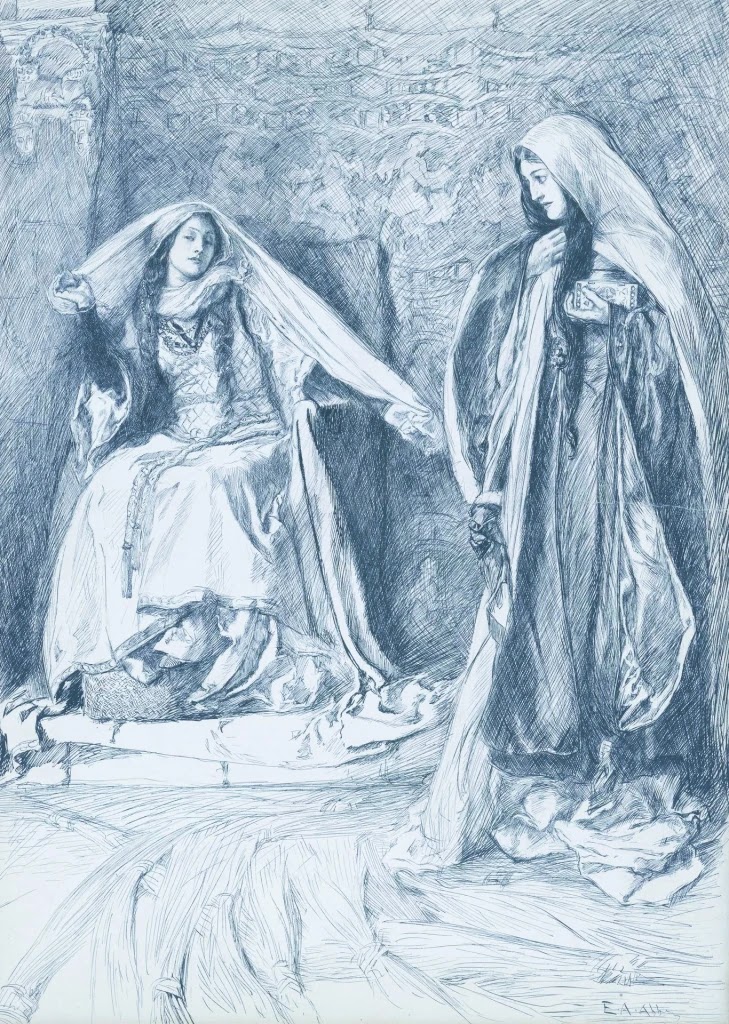
Meta: Rebecca and Rowena; Part I: Introduction

Note: I have been working on this post for several months now, and it just keeps getting longer and longer. As such, I’ve decided to break it down into four parts: the introduction, the novel/parody novella, the films, and the television adaptations.

Every now and then I come back to this article in The Toast about The Unified Theory of Ophelia, in which the author half-jokingly claims that they once believed everything there was to know about womanhood could be discovered in the character of Ophelia.

I had a similar revelation last year on reading Walter Scott’s Ivanhoe and watching its assorted film and television adaptations (plus, William Makepeace Thackery’s parody novella). Everything about how female characters are portrayed across media, how fandom responds to them, and even how Love Triangles and Fan-Preferred Couples form in the imaginations of readers/viewers, can arguably be found in media’s collective portrayal of Rowena and Rebecca across the centuries.

Source

I would go so far as to say that the genesis of all fandom’s discourse and harassment and cross-examination and hypersensitivity and preoccupation with female characters and the role they play in any given narrative can be traced back to these two fictional women. Is that too broad a claim? Yes, of course – but as the linked article points out, every now and then certain theories and concepts that interest you can occasionally seem to magically coalesce into a single, shining, straightforward example. It’s like discovering the unifying theory of the universe.