Search This Blog

Saturday, May 1, 2021

Woman of the Month: Contessina de' Medici

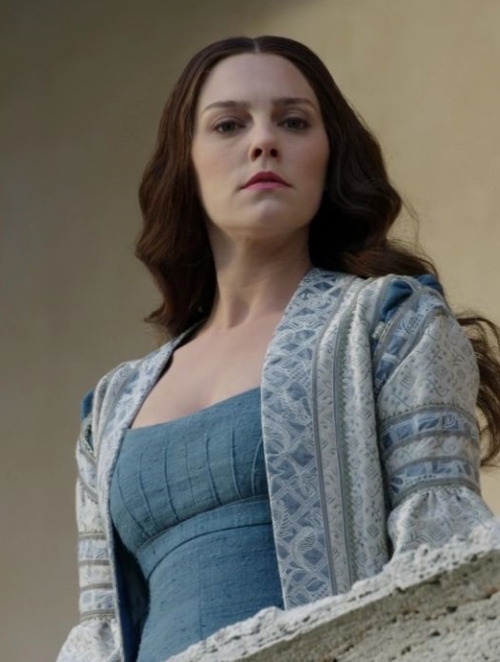
Contessina de' Medici from Medici

When I finally settled down to watch all three seasons of Medici, I was hoping that at least one of the female characters would prove interesting enough to justify one of these monthly posts. And thankfully there was: Contessina de’ Bardi, who becomes the matriarch of the powerful de’ Medici family through her marriage to its eldest son Cosimo.

Female characters in period dramas always interest me: how they’re depicted, what their storylines involve, and how they negotiate the restrictive standards of the time. There’s often a self-consciousness (especially in male writers) about how modern expectations might influence how audiences perceive these women. Does anyone really want to watch a perfectly submissive doormat who acquiesces completely to her father and then her husband?

Should these women anachronistically rail against the patriarchal injustices surrounding them? Should they quietly accept them? Should they push back in subtle or overt ways? Should they be self-aware about the obstacles they face? How much agency and power should they command?

As much as I enjoyed watching Contessina ride her horse into the Signoria to speak in her husband’s defense, it’s obviously not something that a woman of her standing in that period would have ever gotten away with. But it’s also really cool, so it feels counterproductive to complain about it. Where do we draw the line between respecting the role women played in the distant past, and allowing them the autonomy to be active participants in the modern stories we’re actually watching?

It’s a tricky balance, but I feel that Contessina achieved it more effectively than any of the other featured female characters. Lucrezia is a valued wife and mother, Clarice is the conscience and helpmate of her husband, the likes of Caterina Sforza and Ippolita Sforza are allowed a certain degree of political acumen, but Contessina is easily the most self-possessed and authoritative.

Where other women are soft and feminine, she’s hard and intellectual. Her Character Establishing Moment involves her confronting two desperate men trying to break into her home to steal gold; she coolly informs them that money is only to be found at the mint (after removing her valuable earrings, of course). Even as she’s strong-armed into marriage by her father, she tries to meet the situation on her own terms, clinging to her sense of dignity with all her strength.

There is plenty of bittersweetness to her life story: she was romantically attached to another man before her father arranges her wedding to Cosimo, and at one point she says that her husband didn’t really warm up to her until after she gave birth to a son (makes you wonder what would have happened had she had a girl). She grits her teeth and endures the indignity of Cosimo bringing his mistress into her home, though struggles more with the unfairness of him blaming her for saving his life when he had already resigned himself to a martyr’s death.

She definitely gives Cosimo more chances than he deserves, but then – what choice does she have? None but to embrace the role of devoted wife/mother that society has assigned to her, even though you can tell it doesn’t fit her particularly well. But she’s nothing if not self-aware, clearly articulating what’s expected of her, how she can achieve it, and demanding respect for her loyalty and duty.

Men in period dramas have a way of ignoring the sacrifices that their women are making, and though Cosimo finally gets something resembling a clue as to how amazing and valuable his wife is, most of Contessina’s pain and suffering remains private – as would have been the case with essentially every single woman throughout history. She may not get the respect she deserves from the people around her, but she definitely does from the audience.

Reading/Watching Log #64

This month involved a concentrated effort to watch a selection of shows and films that were (somewhat) connected through either theme or content, which meant that I got through a lot of stuff. Generally speaking it involved puppetry, the Golden Age of Hollywood, and the trio of animated Cartoon Saloon films.

That said, I’m going to hold off talking about The Secret of Kells, Song of the Sea and Wolfwalkers until next month, so I can do a proper post on them. (For now – just watch them!)

I also made a miniscule dent in my TBR pile, so a few books can be taken from the pile on the floor and put into an actual bookshelf. Hey, it’s a start!

Sunday, April 11, 2021

The Legend of the Seeker: Revenant

The one with the flashbacks...

This is probably the best episode of the mid-season slump (which won’t pick up again until after the Hartland arc) if not just because I love distant-past flashbacks. This has Richard, Kahlan and Zed finally reaching the much-discussed tomb of a former Seeker, intending it to be a secure hiding place for their Box of Orden.

It gets in some good ghost story clichés, from the opening Stinger with the hapless grave-robbers, to the eerie sight and sound of a weeping woman in white, and they also throw in something of a Rashomon Style backstory for Kieran and Vivienne, a Seeker and Confessor of ages past. Richard reads of them dying noble deaths, having won victory over their enemies and dying together on the battlefield, their last moments recorded by the wizard Amfortus – only it turns out that this is a complete fabrication, designed to hide their more sordid end.

The main problem with this is that the history of the Seekers is infuriatingly vague. Who were these guys? How many have there been? What exactly was their purpose? Are they always paired with a Confessor? Is Richard the first one since Kieran? How does each one get chosen? None of these questions are answered to any satisfactory degree, which is a shame for what could have been an important world-building episode. Instead, the trio of Kieran, Vivienne and Amfortus are fairly insubstantial stand-ins for Richard, Kahlan and Zed, giving us the chance to contrast and compare our current trio with counterparts that made all the wrong decisions...

Saturday, April 10, 2021

Angela Barrett: The Restless Girls

Jessie Burton’s The Restless Girls is a retelling of The Twelve Dancing Princesses, which relocates the traditional fairy tale to South America and gives it a feminist makeover. No spoilers but... look, simply saying there’s a twist regarding the identity of the soldier that’s brought in to investigate the mysterious disappearances of the king’s daughters each night is enough to clue you in as to what the twist actually is.

This is one of Barrett’s most recent projects (published 2018) and it keeps her within her fairy tale wheelhouse. Yet unlike The Wild Swans and The Snow Queen, which take place in the expected settings of medieval Europe, this story’s locale veers more closely to the Venetian colour and warmth of The Most Wonderful Thing in the World, with Barrett conjuring a bright South American coastal city, reminiscent of Salvador or Rio de Janeiro.

Thursday, April 1, 2021

Woman of the Month: Raya

Raya from Raya and the Last Dragon

I wish Raya and the Last Dragon had had more of a chance to thrive at the box office, but there was no avoiding the shadow of Covid-19. Hopefully it’ll gain some traction once it comes off the premiere access fee that Disney+ set up for it.

The movie itself has its problems, but our heroine is not one of them. Living in what is perhaps the darkest setup that a Disney Princess has ever endured (Rapunzel’s was pretty bad too, but the film never delved too deeply into her trauma) Raya’s world is under constant threat from creatures known as the Druun, whose touch turns any living creature to stone.

Distrustful but never unkind, Raya is on a self-motivated quest to find the dragon Sisu and the missing pieces of the gemstone that might destroy the Druun once and for all, and – like most modern princesses – has a skill-set that gets her where she wants to go. Having been trained as a guardian to the Dragon Gem throughout her childhood, she's in possession of a Cool Sword that doubles as a grappling hook and an adorable pangolin/pill-bug mount that rolls her across the landscapes of Kumandra.

Her trust issues are apparent from the beginning, having once made the mistake of showing Namaari, the princess of a rival kingdom, the secure cavern where the unbroken gem was kept. This lapse in judgement cost Raya her father, and is the inciting incident that sets her out on her eight-year quest.

There’s real poignancy in the fact she’s trying to right a wrong that was never really hers to fix in the first place, carrying the burden of her childhood mistake and the guilt that it’s causing so much pain and destruction across the world. Between Kelly Marie Tran’s voicework and Raya’s obvious trust issues, you can feel the deep weariness in the character’s soul.

It’s pretty intense for Disney, and perhaps it was just my imagination, but there seems to be subtext throughout the film suggesting that Raya doesn’t truly believe she’ll be able to fix the world. Rather, she’s trying anyway out of respect for her father’s last wishes, and because there is simply nothing left for her to live for. If I wanted to go really dark, I could posit that her final decision to give up the gem is less a leap of faith and more a final surrender.

I do wish they had handled her arc a little better, especially when it comes to her trust issues with Namaari, but she’s easily the best part of the film, and her long-awaited reunion with her father is a slam-dunk.

Wednesday, March 31, 2021

Reading/Watching Log #63

If there was a theme to this month’s reading/watching material it was the Italian Renaissance, though that ultimately only counts for two of the many things I worked through in March. Alice Hoffman's City of Masks is heavily based on the Venice of this time period, whereas three seasons of Medici covered five generations of that famous family.

It also ended up being a month for Robin Hood due to being reminded (somehow) of the old BBC show, which I loved dearly and which broke my heart, so I sated my thirst for this particular legend by tracking down the two most recent filmic adaptations (though "recent" is relative, as one of these movies is already over ten years old). 

I also finished my last library book of the year. From now on, I have to read my OWN books. and hopefully make a substantial dent in the giant piles of books dotted around the place.

Monday, March 22, 2021

Xena Warrior Princess: Vanishing Act, Sacrifice Part I and II

And we’ve made it to the end of season three! It’s general consensus that this season contained the very best of Xena Warrior Princess, what with its flashbacks and comedies and very real sense of stakes, pathos and drama. It was not without controversy (the Gab Drag) or a few duds (Forgiven, King Con) but it undoubtedly featured the very cream of the crop (The Debt two-parter, Maternal Instincts, The Bitter Suite, One Against An Army, When in Rome), all episodes that are imminently rewatchable, even decades after they first aired.

With Forget Me Not, they even managed to make a clip show episode fascinatingly relevant to the characterization and continuity of the show, and (miracle of miracles) many of their comedy episodes (Been There, Done That, The Quill is Mightier) are actually funny.

We got Gina Torres as Cleopatra, Jennifer Ward-Lealand as Boudicca and Jacqueline Kim as Lao Ma, three wonderful female guest star/characters, and even some of the less-than-stellar episodes had some interesting ideas (I’m sorry we never saw Glaphyra and Darnelle again, and there was potential to Tara even if they mishandled her introduction). And of course, the whole Hope arc, which reaches its climax (though not strictly its conclusion) here.

As it happens, this season ends with what is widely considered the worst episode, followed by a concluding two-parter that’s considered the best finale the show has to offer. That’s Xena in a nutshell: the highest heights and the lowest lows.